Sunday, November 13, 2011

2nd Brand - Colgate... a brand on all fronts?

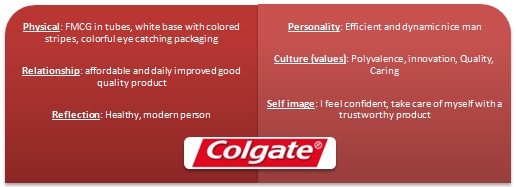
According to Datamonitor 360 (link number 1 in sources below): “Colgate-Palmolive Company (Colgate-Palmolive or 'the company') is one of the leading consumer product company's in the world. It offers products in various categories including oral care, personal care, household surface, fabric care and pet nutrition.” Please find below the brand identity prism of Colgate:


Taken from the Colgate’s annual report:
Q. Amid today’s heightened competitive environment, what is Colgate doing to better connect with consumers?
A. When we think about driving our growth with consumers, we focus on targeting our commercial investment to both build brands with our traditional marketing programs and build trial for the new products that we are bringing to the marketplace.
[…] engaging with consumers must include very powerful and effective in-store shopper marketing activities to com­plement our advertising in traditional media outlets. […] our integrated marketing campaigns are making much greater use of digital tools […]. [F]or in-store activity, one example is using a demonstrator to explain how Colgate Sensitive Pro-Relief toothpaste provides instant and lasting relief from pain […] while distributing product samples for consumers to try for themselves.
As a result […] Colgate’s long-term global market shares have strengthened despite periods of heightened competitive activity. As we enter 2011, we are planning for even greater levels of advertising investment, both in and out of the store, […] to strengthen our worldwide market share positions.  
  • A very diversified brand portfolio: one toothpaste per customers?
Kids market
 
Source: Signal.com

Colgate’s kids universe is much more developed than the competitors. The very detailed website category for children is used to create long and durable brand awareness and knowledge. Indeed, both mother and children will be interested in the brand as it is serious for the parents (lots of information) and funny for the children (funny design). 

Colgate appeals to kids on an emotional level with animation characters they love. They also appeal on a psychological level to the parents because they feel like they make the best to take care of the children.

Colgate is trying very hard to reach that segment with lots of innovative strategies. Indeed, during various annual events like “Oral Health Month”, they give free gifts with a special way to show the brand. This kind of advertising campaign is really innovative and original. It reminds us the way Skip promotes its laundry washing products: encouraging kids to get dirty in order to wash their clothes!


Young people market
Source: Signal.com
Source: Official Colgate Max White One Facebook page

Colgate’s universe for young people is focused on seduction, funny colors and activities, partnerships with “hype” and attractive companies (radio for example). They even organize events with young people based on Facebook pages (targeting young techies).

Colgate tries to catch the attention of the newly independent adults by creating a “community” feeling even if we are talking about toothpaste! This technique is based on what relates to the young people to create brand awareness. Thanks to campaign like “Bye bye les accessoires”, they try to stand out from the mass and be visible when the young people go into the shops for example. They know the brand and learn about it in a funny way.

Colgate is trying to catch the attention of the young customers with a disruptive and funny campaign. People can have whiter teeth by using the Iphone application and then post these pictures on Facebook. We think that this is interesting because it shows that behind the funny application; it proves that young people are interested in the aesthetic feature of the product and need this brand benefit. 


Adult and old people market 

 Source: Signal.com

Colgate’s universe for adult people is much more focused on scientific information and anti-age perspective. Colgate is taking advantage of its leading position to propose health oriented products as the one we can find in the pharmacies. Regarding these products, they have to explain everything with scientific details because they want to appear “serious”. Consequently, they increase brand knowledge with a large amount of information.

They try to appeal to the adults and aging population thanks to emotion, psychological and functional level. Indeed, they focus on the anti-age effect of the toothpaste for aging people who want to take care of their health the best possible. They also launch highly specialized toothpaste that appear as “professional” for the customers.

Colgate seems to seek hard to maintain its brand credibility. Indeed, according to the annual report of the brand: “Colgate’s strong relationships with professionals have contributed to making Colgate and Hill’s the most recommended brands by dentists and veterinarians worldwide. Professional endorsements build credibil­ity for Colgate’s brands and drive product trial.” They have many connections to appear as offering a professional service at home.
  • A "targeted approach" with a LOT of different products.
According to Paul Lukas, journalist on brandchannel.com (http://www.brandchannel.com/features_effect.asp?pf_id=39), Colgate does, with its huge product line, what is called a "targeted approach". This can be a good technique only if all the products are relevant. He explains that there are, sometimes, very similar products that become difficult to differentiate in the toothpaste products.
However, as he states: "
One of the toothpaste is billed as being "For Sparkling White Teeth"; another is "For Clean, White Teeth"; and a third is "For Sparkling, Healthy White Teeth." Can you guess which one goes with which toothpaste?"
We can wonder if the product benefits and positioning for each product is very clear.
  • Colgate’s brand positioning as a “dental cosmetic brand”
According to this article on Datamonitor 360 (link number 2 in sources below): “Specialist whitening brands, such as Clinomyn and Rembrandt are long established, however mainstream brands, like Colgate's Sparkling White, have only recently used 'whitening' as part of the brand name.”

This information is very interesting because it confirms that mainstream brands can have a brand positioning close to specialized brands. By adding this kind of features to the toothpaste, the company is enlarging its target and tries to develop its brand trust.

This new positioning is very trendy and translates the needs of the customers into concrete brand benefits. Many mainstream brands are using it at the moment (Crest by P&G also focus on it with its “Crest Rejuvenating Effects”).
  • Colgate’s brand positioning as a “natural brand”
According to Datamonitor 360 (link number 3 in sources below), building brand trust and legitimacy is difficult for mainstream brands inside specialized markets like “natural” markets.

Indeed, they explain that “marketing natural products requires an understanding of niche market consumers, who tend to be skeptical of mass market companies operating in the natural products sector. If these new products are to be successful and provide the needed boost to volumes and margins, Colgate needs to match the message to the product and understand the natural is essentially a marketing and retail strategy.”

Consequently, the marketing strategy must be very well done to attract the attention of these customers. Many customers are currently asking for natural and organic products and the brand is trying its best to translate the needs of the customers into brand benefits. 
  • Colgate’s newest weapon: Colgate Sensitive Pro-Relief. 
Colgate launched its Colgate Sensitive Pro-Relief toothpaste in 2011. Thanks to this innovation, Colgate have a serious competitive advantage among the other mainstream brands in the market. Indeed, their explanation about this product is very technical and medical. They manage to build brand trust thanks to this strong product.

According to Datamonitor 360 (link 4 in sources below) the company “will revolutionize the way millions of consumers treat and prevent sensitivity pain.” This sentence is very interesting because Colgate’s brand reputation seems really indestructible. They are “revolutionizing” the way people feel, which is quite exaggerating but focus on the strong knowledge and the “savoir faire” of the brand.

The description of the new Colgate’s product is very health oriented and the brand promise is really surprising: “"New Colgate Sensitive Pro-Relief toothpaste is clinically proven to deliver faster and long-lasting sensitivity relief versus a leading sensitive toothpaste. Its proprietary formula penetrates to the source of pain, the nerve, to soothe the pain faster, shielding the nerve to prevent the pain from coming back."

According to the annual report of the brand: “Colgate connects with today’s consumers globally is by utilizing integrated marketing communications that include a mix of traditional and non-traditional media. The launch of Colgate Sensitive Pro-Relief toothpaste leveraged multiple digital touch points, including infor­mative product web sites and online media […], consumer testimonials. These activities, combined with more traditional media and promotional events, are contributing to market share gains worldwide.”

Do not forget to brush your teeth after eating... do not worry Colgate will remind it to you anyway!

Saturday, November 12, 2011

1st Brand - Email Diamant - What if…we color our teeth in red?

A
h… Email Diamant…Its baroque packaging, and its emblematic red toothpaste has not changed since 1893. Today, Email Diamant is considered as a specialist on the niche market of whitening toothpastes.


Actually, teeth get darker naturally and they also lose their white color because of things we consume (wine/ coffee/ tea/ cigarettes…) and people want to have white teeth because it is a sign of a good health, attractive and fashionable (all Hollywood stars get a white smile). An obvious idea came automatically to my mind: Those who get a white smile would be more self-confident than those who have not! As simple as that ;)
Source: http://liverpool.adzooks.co.uk/for-sale/other/gordon-moores-toothpaste-is-back-4255781.html
Email Diamant started to sell its product in 1893, when people were not so interested in having a beautiful white smile. Thanks to this avant-garde idea, people consider Email Diamant as a specialist on the whitening toothpaste market. Hence, Email Diamant helps women from 30 to 50 (their core target), to be attractive and more self-confident with a perfect white smile.


It costs around €3.50 and is sold in supermarkets and drug stores. It is a brand of Laboratoires Santé beauté’s portfolio (which also sells Barbara Gould/ Linéance/ Poupina/ Nair/ Femfresh).
All these brands are not very innovative and quite old-fashioned.


However, Email Diamant makes the most of the natural, organic and vintage trends.
It is considered as a “basic” in our bathroom. Even though it is kitsch, people still love it and have affection for this brand. It is as worthy as our grand-mother secret - with no bad breath of the granny ;).


Email Diamant founders, a couple, were good marketers. They colored the paste into red so that everyone could recognize easily any red toothpaste as an Email Diamant one.
They also asked their son, André, a baritone performing the role of Figaro in the play “le Barbier de Séville”, who gets a beautiful smile to be the muse of the toothpaste.

Source: http://timbreetdent.free.fr/sujets/carte-pub.htm
What is interesting to notice is that Email Diamant has never changed its packaging over the years. It has stuck to the opera singer for all its seven products.
Thus, people can easily recognize Email Diamant packaging while is harder to do between Colgate and Signal which are more similar.


In fact, if we compare major toothpaste brands packaging and hide the name of the brand it would be very difficult to differentiate them, while Email Diamant packaging is easily recognizable and is the same for its 7 products.


Plus, on its website, Email Diamant does not claim to be an oral hygiene specialist (Colagate and Signal claim), but rather a whiteness specialist. It is not giving you white teeth, but an Email Diamant smile. People even say they get a Email Diamant smile instead of a Hollywood smile.


Tradition, elegance, beauty and glamour are the values of the brand, which are associated with seduction. Below is the Kapferer brand identity prism model to understand better Email Diamant identity.


We want to show you an old commercial for Email Diamant starring a famous French Actress Arielle Dombasle. It puts the emphasis on the idea that celebrities also use this product, if you use this toothpaste you will be glamorous and attractive.


In Email Diamants commercials we can always see women with a perfect white smile are kissing men. They are obviously self-confident. The commercial always took place in a baroque environment (opera music, Greek statues…).


People can identify a white smile as an Email Diamant smile (in the latter ad the man says: "this smile??!!...Email Diamant!"). The brand is always using the same slogan “la magie du blanc” (White Magic) to emphasize the fact they perfectly know how to get teeth white.


You can watch the latest commercial of Email Diamant in our previous article Sensational toothpaste.
  
So girls, are you ready to get an Email Diamant smile?
Source: http://www.beautybombshells.com/2010/07/26/bright-white-hollywood-smile/

Friday, November 11, 2011

A bit of fun... for the week end!


Before analyzing in depth 5 toothpaste brands… let’s have a look at the weirdest toothpaste ever! 


  Whiskey, champagne, bacon... so many choices... but which one are you going to buy?! Click here http://www.oddee.com/item_97125.aspx to see all of them!

Even if this is funny, this is also interesting because we can wonder which kind of consumers would be interested in these products? Is there any cultural barriers for these products? Is over-differentiation the key?

Let's think about that :)

Thursday, November 10, 2011

A little bit of theory - Brand personality!

B
rand personality is a very useful tool in understanding how customers perceive brands. According to Aaker (1997), “brand personality” refers to “set of human characteristics associated with a brand”. Indeed, consumers give human personality traits to brand and image these brands could be celebrities or famous figures for example.
A link is then created with the brand depending on the congruity between the individual’s actual or idea self and the human characteristics of the brand.

According to Plumer (1985), “perception of brand personality can be formed and influenced by any direct or indirect contact that the consumer has with the brand”. Consequently, we think that the packaging, the taste and all the elements composing the toothpaste universe are crucial to create the brand personality (colors, endorsers, slogan…).
We tried to apply these short principles to the toothpaste market and played a little game with some customers (people from the school and from our families). They were asked how they perceive the different brands and what kind of brand personality they attribute to them.
  •  Signal and Colgate
On the whole, people associated quite the same words for Signal and Colgate:
- “Pale”

- “Strong”
- “Fresh”
- “Fun"
- “Trustworthy”
- "innovative"

When they were asked, they agree on the fact that if Signal or Colgate was a character, it would be a man.
According to our sample’s reactions, we would portray these two brands as a young and dynamic man!
> Which "big 5" correspond to this brand? Competence
  • Sensodyne

    Regarding Sensodyne, people point out different adjectives:
    - “Medical”
    - “Serious”
    - “Efficient”
    - “Trustworthy”
    People admit that they were able to decide if they would represent this brand with a male or a female person. Consequently, we would portray this brand as below with several doctors.
    We notice that even if Sensodyne is not terribly differentiated, it seems to have quite a different brand personality in the consumers’ minds.
    > Which "big 5" correspond to this brand? Competence.

    •  Email Diamant 

    We were amused when we asked people about Email Diamant:
    - “Pale"
    - “Baroque”
    - “Old fashioned”
    - “Seduction”
    The words were really different compared to Signal and Colgate. Consequently, we notice that creating a brand personality is part of the differentiation of a brand. It can really help you standing out in the crowd (even if we know that this brand is smaller than its competitors).

    When they were asked, people told us they rather identified this toothpaste more with a woman than a man. According to these words, we would portray this brand as besides.

    > Which "big 5" correspond to this brand? Competence and Sophistication.
    Conclusion
    Every single decision of the brands regarding its universe, product line or advertising campaign is decisive in the way people consider them. 

    Tuesday, November 08, 2011

    Analysis of the competition: how to stand out?


    H
    undreds of existing brands of toothpaste occupy the French market and as we mentioned earlier the bestsellers are (in order of market share) Signal, Colgate and Aquafresh. 


    The toothpaste market is a mature but still growing market and the marketing strategies of the main competitors is all about improving product quality, adding new product features, new sorts and flanker products, entering new market segments, new distribution channels and so on, to strengthen the firms competitive position.

    The toothpaste industry is one typical model of a monopolistic competition this means that it’s a cross between a perfectly competitive market and a monopolistic market.
    Each firm produces a toothpaste which is differentiated (i.e. different in character) from all other toothpastes produced by the other firms in the industry. Thus one firm might produce
    a red, white and blue toothpaste with a spearmint taste, another might produce a white toothpaste with a wintergreen taste. This assumption is similar to a monopoly which produces a unique (or highly differentiated) product. Under monopolistic competition, each firm produces a differentiated product. Products are close substitutes but not perfect substitutes. The toothpaste market is a market with many competitive rivals, with similar products that are aimed at the same customer group.

    The differentiated products are imperfectly substitutable in consumption. This means that if the price of one toothpaste were to rise, some consumers would switch their purchases to another toothpaste. From the perspective of a firm in the industry, it would face a downward sloping demand curve for its product, but the position of the demand curve would depend upon the characteristics and prices of the other substitutable products produced by other firms. This assumption is intermediate between the perfectly competitive assumption in which goods are perfectly substitutable and the assumption in a monopoly market in which no substitution is possible.

    The barriers to entry are also relatively low making it easy for new competitors to get in the game.  Typical for a monopolistic competition is that there is free entry and exit of firms in response to profits in the industry. Thus if one toothpaste company are selling well and making profits on a type of toothpaste, it sends signals to the competitors to open up or start selling similar toothpaste.
    Thus, the market is fragmented and the brands have a hard time to differentiate. As soon as you have come up with something new, the competition will be there and have their own versions of it, right next to you in the store.

    How do they differentiate?
    We have earlier talked about how a brand can differentiate their toothpaste, on feelings,  product features like tastes and so on. Many of the larger brands seem to have a similar strategy with large amount of product offerings, trying to offer a toothpaste for every age and thinkable problem that could occur. Aquafresh have many toothpastes for children and has games and things for younger children on their homepage, and Colgate talks about what happens with the teeth when you get pregnant, just to mention some examples.
    Then we have the “outsiders” with a more focused differentiation strategy, trying to find a niche and compete on a different term.

    For example Sensodyne toothpaste, that also is owned by GlaxoSmithKline like Aquafresh,  has a more serious health- and medicine approach. Giving a solution directed to health problems like prevention of brown teeth for smokers and gum disease, and protection of sensitive teeth. Vademecum is saying that its a little bit stronger than other toothpastes, and that children should use just a small amount, giving the impression of that it is more of a medicine than just a toothpaste with natural ingredients. And we also have the specialized toothpastes that are sold only in pharmacies,  giving them an exclusive distribution to make them seem more medical and exclusive. We also have Email Diamant,  portrayed as the “cosmetic toothpaste”, that concentrates on the cosmetic angle of it, making toothpaste sound like a small surgery enhancement. Looking young and fresh with whitening of your teeth, without going to a professional dentist and getting them whitened. Also Denivite concentrates on a “professional whitening at home”- approach.
    A new differentiation key driver that  is also emerging in the toothpaste market,  is for toothpastes to be more organic, vegetarian and more green and eco friendly.


    There is also the in-store brands that have more of a “no frills strategy”, Carrefour, for example, is offering its own “BIO”- toothpaste, for a smaller amount of money than the similar competitors.

    At a first glance many of the large competitors seem to have similar strategies, but as you can see there is still room for differentiation. Later on in the blog we will concentrate on 5 brands and go in depth, and show you how each of them are trying to keep their differentiation in this large market.

    Sources:
    http://www.colgate.co.uk/app/ColgateTotal/UK/faq.cwsp
    http://www.ooshop.com/


    Keep on Smiling
    Source: Google Image

    Monday, November 07, 2011

    Very Different?

    T
    he market of toothpaste is a difficult and competitive one. In this article we will try to point out some methods that brands are using in their way of differentiating themselves from their competitors.
    Today brands are trying packaging the toothpaste in fun tubes and tactile squeeze bottles. They are managing to mix it up and differentiate, but still it is the traditional paste that is the most desirable among customers, and why this packaging is the most common. It is hard to enter the market with something groundbreaking which will not be met with too much skepticism. However, producers are continuing to try in several ways.
    To illustrate; when Colgate targets the kids segment, it tries to differentiate itself from other brands adding some shining effects to the paste, while changing the color of the paste to gold.
    In addition, it changes the packaging, designing the tubes with figures and drawings and linking them up in connection to the toothbrushes, which is shaped like different characters. Kids get excited when they see more bright colors, things that sparkle and cartoons. Besides, we find that the taste is a bit sweeter than traditional toothpaste, which often can have a strong taste that most kids would dislike.
    Since the toothpaste was adapted into tubes instead of jars, the size has been the same. With exceptions for travel sizes and small tubes for kids, the size is standardized to 100 ml. This is a perfect size that is very convenient and should be kept. But one thing that has been an issue for the consumers is the fact that we never seem to get everything out of the tubes. One attempt to change this is the design of Sang Min Yu and Wong Sang Lee. SavePaste tries to improve the packaging in two areas; eliminate the hard-to-squeeze dead space and minimizing toothpaste residue left inside the container. It means that the consumers can reduce waste and manufacturing price plus encourage recycling. In addition, they have a user-friendly design so that people easily can adopt it. 
    For the taste, there is a major difference between kids and regular toothpaste. Companies try to lure children to make them brush their teeth with sweet toothpaste and put the emphasis on the benefits of their brand to make adults buy.

    As for the coloring goes, it has been mentioned earlier in this blog that toothpaste colors are usually light. We can all agree that black toothpaste do not seem that appealing. Some toothpastes are combining different colors for example red, white and blue like Aquafresh that is known for its three colors. When doing this, brands get three different tastes, three different colors and three different ingredients in the same tube. Actually it is very cleaver because we, as a consumer, automatically assume that they get all in one tube, “the total package”. Other brands are combining different colors to create something unique to their toothpaste. Further, some pastes are also light green or light purple, but these colors are associated to whitening process.
    Hereafter, we will list three different examples of how brands have approached the task of differentiating themselves from their competitors.
    First, we look at Aquafresh Iso-Active Whitening. Aquafresh introduced this breakthrough technology in toothpaste in 2010. In 2011 it won consumer survey on product innovation in USA. This toothpaste was a brand new approach to total oral health and is meant to compete with Colgate Total. Further on, Aquafresh Iso-Active is delivered in a revolutionary canister. The paste inside as actually a gel that transforms into a deep-cleaning foam and disperses active ingredients. Aquafresh said that this provided the best way of cleaning that had ever been possible.
    Second, and the most daring idea for a toothpaste brand came from Hattomonkey. They created a brand name and packaging design for the conceptual new black toothpaste Noon.

    With this minimalistic approach they showed that it is possible to do something completely different to stand out.
    Finally, we just want to include two examples of how to stand out from competition via taste... Though we doubt it would be a success!
     
    
    http://www.mcphee.com/shop/products/Bacon-Toothpaste.html
    
    
    http://ytie.com/cupcake-toothpaste/
    To conclude, all these four products above illustrate that toothpaste manufacturers are trying to differentiate themselves in different ways. Some play on colors, others on texture while some even play on taste. Again, it is all about standing out and on a mature and competitive market, but it is not an easy task to do as people have a strong view about how should a toothpaste be. Differentiation could be accepted either by children or by youngsters that are fond of new trends. However, it is exciting to follow new trends on the toothpaste market, that are sometimes quite strange, sometimes totally amazing...
    Until next time Keep on smiling

     
    Source: Google image

    Friday, November 04, 2011

    Bad Breath DetectoRRRrrrr

    H
    i there!
    We could not help showing you an incredible video found on YouTube on Iphone’s most hilarious application called « Bad breath detector ».


    Smile,
    it’s nearly the weekend!
    
    Source: http://www.likecool.com/take_a_smile--Pic--Gear.html